Oratory Crossword Clue
Introduction: Understanding the Clue “Oratory”
The crossword clue Oratory is widely used across daily, cryptic, and themed puzzles due to its flexibility and rich meaning. At its core, oratory refers to the art or skill of public speaking, combining eloquence, persuasion, and structured communication. Crossword editors exploit this definition to craft clues of varying difficulty, often hinting at synonyms like RHETORIC, ORATION, or ELOQUENCE.
Understanding this clue requires solvers to recognize both the skill and act of speaking, as well as subtle differences in connotation. Mastery of this clue improves vocabulary, logical deduction, and contextual reasoning skills that extend beyond crosswords into communication and problem-solving.
Meaning of Oratory in Crosswords
In crossword puzzles, Oratory primarily refers to the technique or style of formal speech. Unlike casual conversation, it emphasizes clarity, structure, and persuasion. Editors may choose this clue to guide solvers toward words reflecting public speaking ability, the act of delivering a speech, or rhetorical skill.
The clue may vary in complexity depending on word length or puzzle type, which challenges solvers to think critically about language and context. Recognizing these nuances allows players to approach the puzzle systematically, evaluating not only the literal meaning but also historical and stylistic implications.
Oratory Crossword Clue Solutions
Use the filters or search box to find the right solution for your puzzle.
| Word Length | Solution | Meaning / Context | Difficulty / Use | Notes |
|---|---|---|---|---|
| 4 | TALK | General speaking | Beginner / Mini puzzles | Short, casual communication |
| 4 | RANT | Forceful speech | Beginner / Mini puzzles | Informal or emotional communication |
| 6 | SPEECH | Act of delivering a talk | Beginner / Standard | Broad usage |
| 7 | ORATION | Formal speech | Standard / Medium | Focuses on a single speech event |
| 7 | HARANGUE | Forceful speech | Medium / Advanced | Slightly negative connotation |
| 8 | RHETORIC | Art of persuasive speaking | Standard / Popular | Most common answer for Oratory clues |
| 9 | ELOQUENCE | Skillful and persuasive expression | Advanced / Themed | Highlights style and fluency |
| 14 | PUBLIC SPEAKING | Act of addressing audiences | Advanced / Themed | Broader, contextual solution |
| 17 | COMMAND OF LANGUAGE | Mastery of speech | Advanced / Cryptic | Used in themed or cryptic puzzles |
The Most Common Answer: RHETORIC
The word RHETORIC appears as the primary solution for Oratory in most crosswords. It is an eight-letter term that embodies the art of persuasive speaking, including both style and effectiveness. RHETORIC’s frequent usage is due to its precision, appropriate length for standard grids, and alignment with the clue’s meaning.
Across publications like The Guardian, The Telegraph, and The Sun, this solution consistently appears for intermediate and advanced puzzles. Understanding why RHETORIC is preferred helps solvers identify likely answers even when only partial letters are visible, making it an essential word to memorize for frequent crossword solvers.
Alternative Answers for “Oratory”
While RHETORIC is the most common answer, several alternatives are context-dependent. ORATION (7 letters) refers to a formal speech, ELOQUENCE (9 letters) highlights persuasive skill, SPEECH (6 letters) represents general speaking, and HARANGUE (7 letters) implies a forceful, sometimes critical speech.
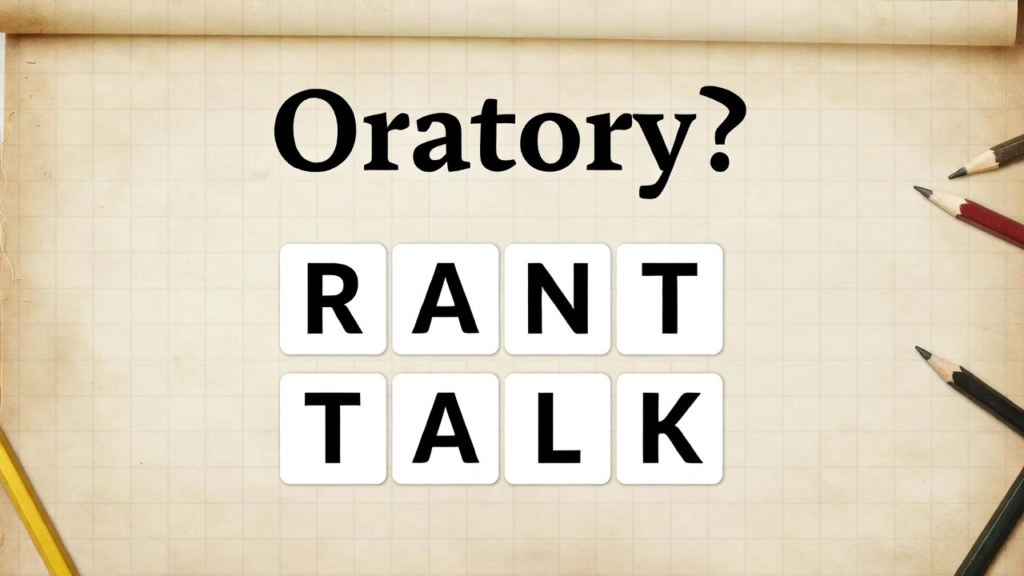
Shorter options such as TALK (4 letters) appear in simpler or digital crosswords. Solvers must consider word length, intersecting clues, and context words such as “formal,” “persuasive,” or “skill” to determine the correct solution. Recognizing subtle differences between these options is crucial for success in complex crosswords.
Short Answers: Quick-Solving Strategies
In mini puzzles or beginner grids, Oratory often corresponds to shorter words like TALK, RANT, or SPEECH. While these answers are simpler, they still capture the essence of public speaking. These short solutions are ideal for timed solving or when crossing letters are limited.
Solvers should remember that even small words carry meaning and can provide clues for adjacent answers. Observing patterns and matching clue length with context is a proven strategy to solve these short-answer scenarios efficiently, increasing speed without sacrificing accuracy.
Medium-Length Solutions: Contextual Clues
Seven- to nine-letter answers typically demand nuanced understanding. For example, ORATION represents a formal speech, ELOQUENCE emphasizes stylistic skill, and HARANGUE implies a forceful, sometimes long-winded speech. Clues may include modifiers like “formal” or “persuasive,” which narrow down the possible answers.
Recognizing these subtle differences between words allows solvers to choose the most precise solution for their specific crossword. Context is critical: an editor’s choice of clue wording often signals whether the answer should emphasize skill, style, or the act itself.
Long Answers and Advanced Clues
In challenging puzzles, clues may require longer answers such as PUBLIC SPEAKING or COMMAND OF LANGUAGE, reflecting the broader concept of oratory. These solutions appear in themed grids, cryptic crosswords, or puzzles that integrate literary or historical references.
Understanding that oratory extends beyond a single speech to the skill, strategy, and impact of communication enables solvers to interpret these advanced clues effectively. Familiarity with these concepts strengthens both vocabulary and analytical reasoning.
Historical Significance of Oratory
Oratory has been highly valued since classical times. Historical figures like Cicero, Demosthenes, Abraham Lincoln, and Winston Churchill mastered public speaking to persuade and inspire audiences. Crossword editors sometimes incorporate historical context into clues, where awareness of these figures or famous speeches provides hints for the solution. Understanding the legacy of oratory not only improves solving accuracy but also enriches a solver’s appreciation for language, rhetoric, and culture.
Cryptic Crossword Approaches
In cryptic crosswords, Oratory can involve wordplay, anagrams, hidden words, or double meanings. For instance, “Skill in rearranging words (8)” may suggest RHETORIC as an anagram. Solvers must analyze punctuation, clue structure, and potential letter rearrangements carefully.
Recognizing common cryptic devices enhances success with challenging clues, especially when the solution could be metaphorical, historical, or stylistic. Developing this skill separates advanced solvers from beginners.
Real-World Crossword Examples
Analysis of popular newspapers and digital puzzles shows predictable patterns:
- The Telegraph frequently uses RHETORIC or ORATION.
- The Guardian leans toward RHETORIC for standard clues.
- NYT Mini Crosswords favor TALK or SPEECH for concise entries.
Studying these patterns allows solvers to anticipate answers based on the source, clue length, and difficulty, providing a strategic advantage when approaching new puzzles.
Step-by-Step Solving Strategies
- Identify clue length – critical for narrowing possibilities.
- Look for context keywords – formal, persuasive, skill, or speech.
- Check intersecting letters – confirm or eliminate options.
- Consider historical references – helpful for advanced or themed puzzles.
- Eliminate unlikely synonyms – focus on precision rather than general meaning.
Following this process improves speed, confidence, and accuracy across diverse crossword types.
Educational Benefits of Solving Oratory Clues
Solving clues related to oratory enhances vocabulary, comprehension, and critical thinking. It introduces solvers to rhetorical, historical, and literary concepts while improving pattern recognition. Regular practice strengthens analytical reasoning and improves both written and verbal communication skills.
Crosswords with clues like Oratory provide a blend of language learning, cultural awareness, and problem-solving, making them a valuable exercise beyond entertainment.
Common Mistakes to Avoid
- Confusing the act of speaking with the skill itself
- Ignoring clue length or letter constraints
- Overlooking subtle context indicators
- Assuming a short word like TALK always suffices
Avoiding these pitfalls ensures higher accuracy and reduces wasted attempts, especially in puzzles with nuanced or advanced clues.
Tips for Mastering “Oratory” Clues
- Memorize common solutions: RHETORIC, ORATION, ELOQUENCE
- Study classical speeches and historical orators
- Practice analyzing context cues and synonyms
- Review multiple puzzle sources for patterns
- Combine knowledge of vocabulary, history, and context for the best results
These techniques equip solvers to approach this clue confidently in any crossword format.
Conclusion: Why Mastering Oratory Clues Matters
Oratory is more than a simple crossword clue; it challenges solvers to integrate language comprehension, historical knowledge, and critical thinking. By understanding meaning, common answers, alternative solutions, and historical context, solvers can consistently succeed across puzzle types. Combining practice, strategic deduction, and vocabulary mastery ensures proficiency with this frequently encountered clue, making it a cornerstone for serious crossword enthusiasts.
FAQs
RHETORIC is the most frequent solution in standard crossword puzzles, reflecting the art of persuasive public speaking.
Yes, ORATION often fits when the clue emphasizes a single formal speech rather than the general skill.
Absolutely. Words like “formal,” “skill,” or “persuasive” guide the solver toward precise answers.
Yes. Short answers like TALK, RANT, or SPEECH appear in mini or beginner crosswords.
Cryptic clues may use anagrams, hidden words, or metaphorical hints, requiring context analysis and puzzle pattern recognition.
Disclaimer:
The content in this article is for educational and informational purposes only. While every effort has been made to ensure accuracy, it is not professional advice. Crossword answers may vary by puzzle type, publisher, and edition. Readers should verify solutions according to their puzzle context. This guide is intended to improve understanding, vocabulary, and solving strategies for enthusiasts, but individual results may differ.
For More Information, visit newsreflect
About the Author