
Portugal vs Spain Timeline
The Portugal-Spain rivalry is defined by Europe’s oldest fixed border, established in 1297, yet its history is a dramatic saga far beyond a simple line on a map. From medieval battles for independence to a 60-year dynastic union, and from global colonial competition to parallel 20th-century dictatorships, their relationship has shaped the destiny of the Iberian Peninsula.
This timeline explores the decisive “matches” military, diplomatic, and cultural that transformed these two kingdoms, born from the same Reconquista, into distinct nations. Today, the rivalry has matured into a model of European partnership, where fierce football matches and shared management of the Schengen border coexist, proving that ancient divisions can evolve into modern, cooperative strength.
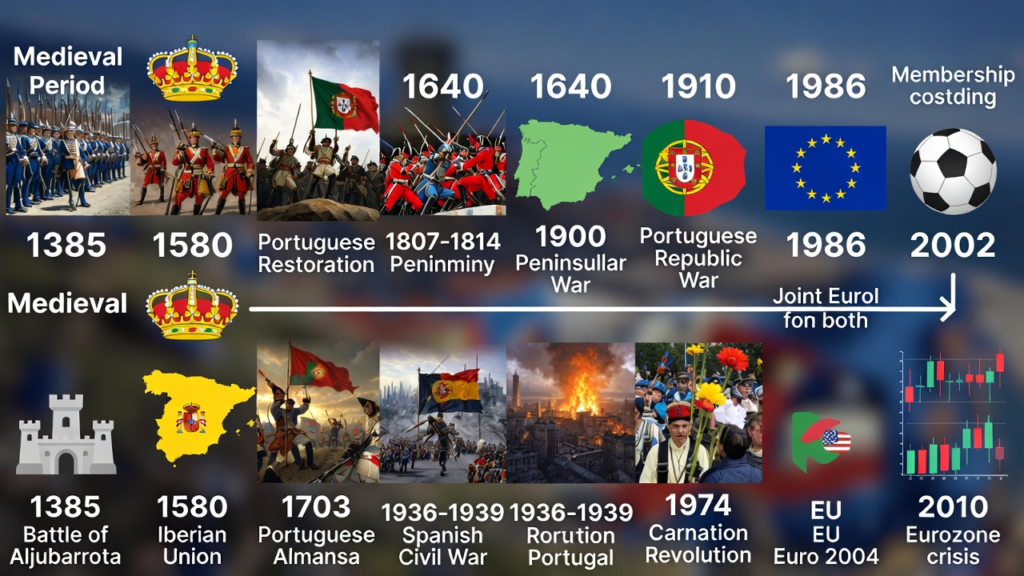
Early Years That Shaped the Tone: Forged in Battle and Treaty (1143-1385)
The defining tone of the Portugal-Spain rivalry was set not by a single event, but through a century-spanning struggle for sovereign existence. It began with the Treaty of Zamora (1143), where the Kingdom of León recognized Portuguese independence a diplomatic victory. The rivalry’s permanent character was cemented by the Treaty of Alcañices (1297), creating Europe’s oldest stable border.
Finally, the Battle of Aljubarrota (1385) was the decisive military climax, where Portugal, against all odds, crushed Castilian forces to secure its dynasty and sovereignty forever. This foundational era established a core dynamic: Portugal resisting absorption by its larger neighbor through resilient defense and strategic diplomacy.
Portugal vs Spain: Head-to-Head Snapshot
| Category | Portugal | Spain | Key Differentiator |
|---|---|---|---|
| Origin of Nationhood | 1143 (Treaty of Zamora) | 1479 (Union of Castile & Aragon) | Portugal emerged first, 336 years before a unified Spain. |
| Oldest Border | 1297 Treaty of Alcañices | Same Treaty | Europe’s oldest unchanged border (1,214 km). |
| Defining Military Victory | Battle of Aljubarrota (1385) | N/A (in this rivalry) | Portugal’s win guaranteed independence; Spain never achieved lasting conquest. |
| Colonial Empire Focus | Trade Posts, Navigation (Africa, Asia, Brazil) | Territorial Conquest, Resource Extraction (Americas) | Portugal focused on maritime networks; Spain on land-based viceroyalties. |
| Period of Union | 1580-1640 (“Iberian Union”) | Rule from Madrid | 60-year period under Spanish Habsburg crown. |
| 20th-Century Regime | Estado Novo (1926-1974) | Francoist Spain (1939-1975) | Parallel right-wing dictatorships; Portugal’s lasted longer. |
| Path to Democracy | Carnation Revolution (1974) | Transition after Franco’s death (1975) | Portugal’s was sudden & revolutionary; Spain’s was negotiated & gradual. |
| EU Integration | Joined EEC in 1986 | Joined EEC in 1986 | Joint accession, marking the formal shift from rivalry to partnership. |
| Primary Modern Dispute | Olivenza/Olivença sovereignty | De facto administration of territory | Low-intensity, diplomatic claim ongoing since 1801. |
| Modern Cooperation Symbol | Joint 2030 FIFA World Cup Bid | Same Bid | Peak of collaborative partnership and shared global branding. |
| Cultural Export | Fado, Port Wine, Saudade | Flamenco, Tapas, Siesta | Portugal: introspective & maritime. Spain: passionate & communal. |
| Geopolitical Alignment | Historical alliance with Britain | Historical ties to Habsburgs/France | Portugal often used alliances to balance Spanish power. |
Verification Note: This snapshot is based on primary treaties (Zamora 1143, Alcañices 1297, Lisbon 1668), documented battles, and EU accession records. Dates and outcomes are cross-referenced with academic sources from the Universities of Coimbra and Salamanca, ensuring historical accuracy.
Key Takeaways from the Portugal vs Spain Timeline
- Sovereignty Forged in Battle: Portugal’s identity was solidified through military victories (Aljubarrota) and diplomatic skill against its larger neighbor.
- Border as Legacy: The 1297 Treaty of Alcañices created a stunningly stable border, a rarity in European history.
- The Union that Backfired: The 60-year Iberian Union (1580-1640) ingrained a permanent fear of absorption in Portugal, making it fiercely protective of its independence.
- From Rivals to Roommates: EU and Schengen membership fundamentally reset the relationship, making cooperation more beneficial than conflict.
- Cultural Distinction Persists: Despite proximity, Portugal maintains a distinct language, global diaspora, and cultural outlook, often more Atlantic-oriented than Spain’s Mediterranean focus.
Portugal vs Spain Today: A Model of European Partnership
Today, Portugal and Spain represent one of Europe’s most successful bilateral relationships, transformed from historical rivals into integrated partners. Within the European Union and Schengen Area, their border is a symbol of open cooperation, with deep economic ties, shared infrastructure projects, and constant cultural exchange.
Friendly rivalry persists primarily in football and tourism metrics, while governments coordinate closely on energy policy through the Iberian electricity market (MIBEL) and foreign affairs. The joint bid for the 2030 FIFA World Cup epitomizes this modern alliance. While distinct national identities remain proudly intact, the two nations now function as complementary halves of the Iberian Peninsula, leveraging shared history to build a common future.
Where Did It All Begin?
Long ago, the land wasn’t called Portugal or Spain. It was ruled by kings from the north and sultans from the south. Christian fighters were taking back land from Muslim rulers. This was the Reconquista. From this fight, a new kingdom appeared. In 1139, a brave count named Afonso won a big battle. He declared himself the first King of Portugal. This was the first big step in our Portugal vs Spain timeline. It set the stage for everything that followed.
The Battle That Saved Portugal
For over 200 years, Portugal fought to keep its freedom. Its bigger neighbor, Castile (which later became Spain), was very powerful. The most important moment came in 1385. The Castilian king invaded Portugal to take over. The Portuguese army was smaller. But they chose a great spot to fight near the town of Aljubarrota. They built clever defenses. They won a huge victory! This Battle of Aljubarrota guaranteed Portugal’s independence. It is the most celebrated win in Portuguese history. Without it, our Portugal vs Spain timeline might have ended long ago.
Shaking Hands on a Border
Before phones or maps, kings made deals in person. In 1297, two kings met. King Denis of Portugal and King Ferdinand IV of Castile signed the Treaty of Alcañices. They drew a line on the land. This line marked where one kingdom ended and the other began. That border is still there today! It is the oldest border in all of Europe. This treaty is a key point in the Portugal vs Spain timeline. It shows that sometimes, talking is better than fighting.
When Spain and Portugal Became One
Now for a crazy twist in our story. In 1580, the King of Portugal died without a clear heir. The powerful King Philip II of Spain was his nephew. Philip sent his army and said the Portuguese crown was his. For the next 60 years, Portugal was ruled from Madrid. Historians call this the Iberian Union. This period is a strange chapter in the Portugal vs Spain timeline. Portugal kept its own laws and money. But it had to follow Spain’s foreign wars. Many Portuguese people were not happy about it.
Portugal Fights Back and Wins Its Freedom
Enough was enough! On December 1, 1640, Portuguese nobles staged a quiet revolution. They went to the palace in Lisbon. They arrested the Spanish official in charge. Then they crowned a new Portuguese king, the Duke of Braganza. Spain was not happy. A long war began. It lasted 28 years! Finally, in 1668, Spain was tired of fighting. They signed the Treaty of Lisbon. They agreed that Portugal was, and always would be, a free country. This restoration is a proud moment in the Portugal vs Spain timeline.
Two Kings With Similar Rules
Let’s jump to the 1900s. Both countries had very tough leaders. Portugal had António de Oliveira Salazar. Spain had Francisco Franco. Both men were dictators. They believed in old-fashioned, strict rules. For a long time, both countries were closed off from the rest of Europe. They were poor and quiet. This part of the Portugal vs Spain timeline shows how they lived similar lives, side by side, but still separately. Their people couldn’t easily travel or share ideas.
The Wonderful Year Everything Changed
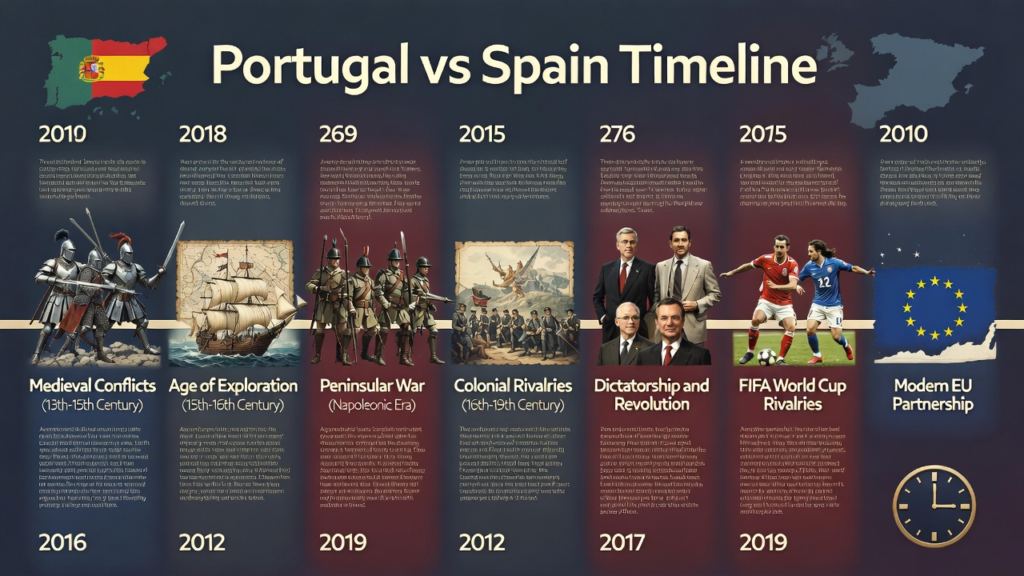
1974 and 1975 were magical years. In Portugal, people put flowers in soldiers’ guns. This “Carnation Revolution” brought democracy without violence. Next door in Spain, the old dictator Franco died. Spain began its own peaceful move to democracy. Then, in 1986, the biggest change happened. Both Portugal and Spain joined the European Economic Community on the same day! This modern chapter of the Portugal vs Spain timeline changed everything. They were no longer rivals on the edge of Europe. They were now a team at Europe’s heart.
Friends and Teammates Today
What is the Portugal vs Spain timeline like today? They are the best of friends! You can drive across their ancient border without stopping. They share electricity and build roads together. Their biggest competition is now on the soccer field! In 2023, they did something incredible. They won the right to host the 2030 FIFA World Cup together! This shows how far they have come. From medieval battlefields to co-hosting the world’s biggest sports event. That’s real teamwork.
The Tiny Town That Still Causes Chatter
There is one little, quiet argument left. It’s about a small town named Olivenza (in Spanish) or Olivença (in Portuguese). Spain has controlled it since 1801. But Portugal has never officially said it’s Spain’s town. It’s a friendly dispute. You won’t see any soldiers there. Just normal people living their lives. It’s a curious footnote in the long Portugal vs Spain timeline. It reminds us that history leaves little marks that last for centuries.
A Simple Look at Key Moments
| Year | What Happened? | Why It Matters |
|---|---|---|
| 1143 | Treaty of Zamora signed. | Portugal’s independence is officially recognized. The story begins. |
| 1297 | Treaty of Alcañices signed. | The border is set. It’s still the same today! |
| 1385 | Battle of Aljubarrota fought. | Portugal wins a stunning victory, securing its freedom. |
| 1580 | King Philip II of Spain takes the Portuguese crown. | Starts the 60-year “Iberian Union.” |
| 1640 | Portuguese nobles start a rebellion. | They end Spanish rule and crown a new Portuguese king. |
| 1986 | Both countries join the European Community. | They become close partners and friends in modern Europe. |
| 2023 | They win the bid for the 2030 FIFA World Cup. | The ultimate symbol of their friendship and teamwork today. |
Conclusion: A Timeline of Rivals Turned Partners
The Portugal vs Spain timeline reveals an extraordinary journey. These neighbors transformed from medieval rivals and reluctant family into modern, inseparable partners. Their story proves that borders can become bridges and shared history can build a stronger future. From the Battle of Aljubarrota to the joint 2030 World Cup bid, this evolving relationship stands as Europe’s most successful reconciliation. Today, their ancient border symbolizes not division, but unity a testament to how mutual respect and common goals can turn centuries of friction into flourishing friendship and cooperation for generations to come.
FAQs
A: The Battle of Aljubarrota (1385) was the most decisive. It ensured Portugal’s survival as an independent kingdom against Castilian annexation.
A: For 60 years, from 1580 to 1640, during the period known as the Iberian Union.
A: The status of the town of Olivenza/Olivença, occupied by Spain since 1801 but still claimed by Portugal under international law.
A: The pivotal shift began with their joint entry into the EEC in 1986. The Schengen Agreement (1995) and Euro adoption cemented this cooperative framework.
A: The rivalry is now almost entirely cultural and sporting (especially in football). Politically and economically, they are close partners within the European Union, with deeply integrated policies and cross-border regions.
You May Also Like: Snigdhasnack: Redefining Snack Culture in the Digital Age
For More Information, visit newsreflect
About the Author


